AI Where It Belongs: The Riigihanked.eu Case Study
A case study on building Riigihanked.eu. Discover how we combine deterministic software with AI to help entrepreneurs, managers, and government officials navigate Estonian public procurement.

There’s a popular, somewhat lazy narrative going around right now that suggests every business process should eventually become a chat window. I don’t believe that. And when it comes to public procurement, taking that approach isn’t just technically flawed. It’s institutionally dangerous.
A procurement process isn’t a vibe. It’s a strict legal, financial, and democratic mechanism for spending public money. It runs on rules that require transparency, equal treatment, open competition, and absolute accountability.
That’s exactly the philosophy behind Riigihanked.eu, the procurement platform I’ve been building. The core idea is deliberately conservative: we use AI only where AI is the right tool, and we rely on deterministic code everywhere the law itself is deterministic.
While the system is specifically designed for the Estonian public procurement landscape, the lessons here apply broadly to anyone building software for the public sector. AI can be incredibly useful in government, but only when it knows its place. It’s fantastic at reading, extracting, drafting, comparing, and explaining complex documents. But it must never be allowed to secretly make the final decision.
We don’t claim that “AI evaluates tenders.” The honest reality is this: deterministic software evaluates what the law makes computable; AI reads, drafts, and explains; the official decides; and every single step is isolated, cited, and fully auditable.
Why Procurement is the Wrong Place for “Magic”
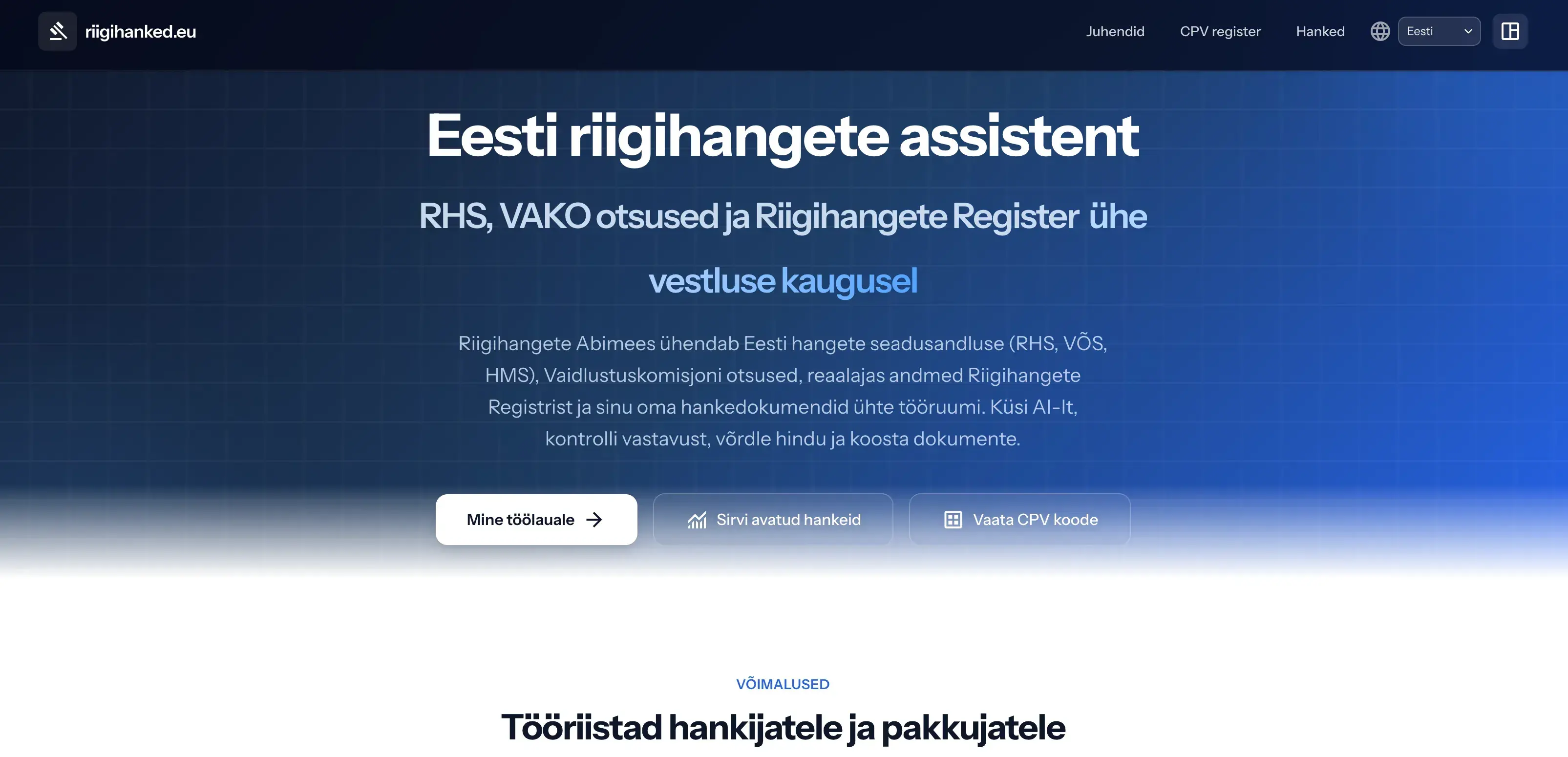
From the outside, public procurement just looks like a lot of bureaucracy. But from the inside, it’s a dense, high-stakes intersection of law, market dynamics, budgets, and human judgment. The EU procurement framework covers a massive economic surface: around 14% of the EU’s GDP, about €2.5 trillion spent by over 250,000 public authorities every year.
That scale makes procurement a tempting target for AI automation. It’s heavily reliant on documents, highly repetitive, and buries structured rules deep inside unstructured text. Officials are overloaded, and suppliers often miss out on opportunities or misunderstand complex requirements. Disputes are common simply because the meaning of a specific condition or document isn’t always obvious at first glance.
But the wrong implementation of AI would just turn this structured process into algorithmic fog. A bad AI system looks at long, messy documents and tries to generate a single “recommended winner” from memory, or tries to do math in a language model, or mixes confidential bidder data into one giant context window.
The right implementation does the opposite. It makes the process more legible. It doesn’t replace the official or the entrepreneur. It gives them a sharper, more reliable instrument.
The Human Decides. Always.
For any manager, product owner, or public servant looking at AI tools, this is the first non-negotiable design rule: the human must remain in charge.
In Riigihanked.eu, the evaluation module is strictly advisory and read-only. There are no automatic award decisions and no “AI approve” buttons. AI-suggested scores are always provisional.
This goes beyond a mere UI preference; it acts as a fundamental governance boundary. The human isn’t just “in the loop” as an afterthought. The human is the loop. The AI proposes, the official reviews, and deterministic code handles the math. Every important result is presented alongside hard evidence. And if the evidence isn’t sufficient, the system tells you so.
Structuring the Process: The Four-Layer Model
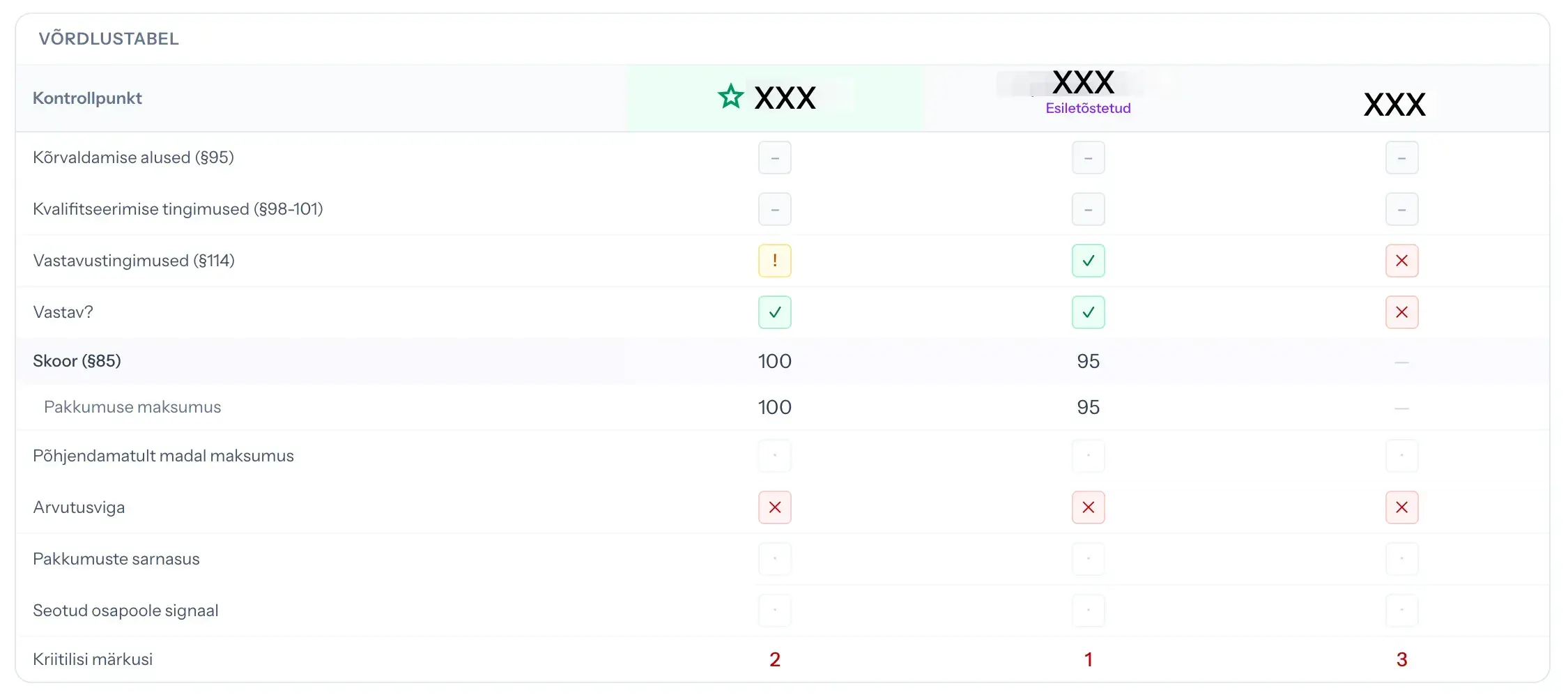
A procurement evaluation shouldn’t be a single block of AI-generated text. The law itself separates different questions, and our software mirrors that structure. We keep four layers entirely separate:
- Exclusion: We check if exclusion grounds apply (like tax debts or sanctions). The AI reads documents and flags missing evidence, but it never infers a clean pass from missing data. The official makes the final legal call.
- Qualification: We map qualification criteria to the bidder’s evidence. The AI extracts evidence from the files and cites exact passages, but final acceptance is always a matter of human judgment.
- Compliance: We compare the tender requirements against the bidder’s offer. The AI locates matching or conflicting passages, while the system enforces strict pass/fail categories.
- Scoring and Award: This is where award criteria and pricing come in. The AI might extract price tables, but all the arithmetic, thresholds, and scoring formulas are computed by hard, deterministic code.
This structure prevents a common AI failure: blending different concepts together. A bidder might meet qualification criteria but fail on compliance. An offer might be fully compliant but contain a math error. A price might be unusually low without being abnormally low in the legal sense. These distinctions are far from academic. They define the process itself.
Confidentiality Built into the Architecture
Structure is only half of the challenge; confidentiality is the other half. Suppliers submit highly sensitive commercial material, and one bidder’s confidential offer must never leak into another bidder’s analysis.
Instead of relying on a privacy policy that we hope developers remember to follow, Riigihanked.eu enforces this directly within its architecture. The data-access layer simply refuses queries that try to read offer data without naming the exact bidder context. One bidder’s text never becomes another bidder’s context.
Good government technology should feel a little boring. It should fail closed. It should refuse attractive shortcuts and make unsafe actions hard to do.
From Experiments to Early Traction
Riigihanked.eu is not our first attempt at this problem. We spent years experimenting around Estonian procurement with a blog, a CPV code search, custom tools, and GPT-based chatbots. Those experiments taught us what bidders and officials actually need, and they are the reason the architecture above looks the way it does. The current version took about three months to go live.
The build itself was heavily AI-assisted. We leaned mainly on Claude and Gemini, with many other models playing supporting roles. The result is a system that holds over 70,000 tenders today. In its first month live, it reached:
- more than 2,500 users (per Google Analytics)
- around 1,800 clicks from Google Search
- over 80 registered users
We also became one of the top Google results for procurement-related searches in Estonia. For a niche GovTech product in month one, that is a solid start. Early traction doesn’t validate the philosophy on its own, but it tells us the demand is real.
The next phase is less about shipping features and more about listening: customer studies, tighter feedback loops, and direct cooperation with government organizations to make the product better for the people who depend on it.
The opportunity is also bigger than Estonia. The system already works with TED XML forms, the EU’s standard format for procurement notices, and is built around the EU procurement directives. Extending across the EU is a natural next step, not a rewrite.
What I’m Doing and How I Can Help
Building Riigihanked.eu has taught me a great deal about applying AI thoughtfully in complex, high-stakes environments. But it’s just one piece of what I do.
I’m currently focused on building intelligent, agentic systems that solve real business problems without the typical “AI hype.” Alongside Riigihanked.eu, I’m also building Perxify (an AI-powered commerce and loyalty platform) and Raamatuhai / BooksShark (an Estonian book marketplace). I’m heavily involved in the AI-assisted engineering movement through AI Coding Eesti, where we help senior engineers, tech leads, and founders build the next generation of software using LLMs safely and effectively.
For entrepreneurs, product owners, and managers, navigating the AI landscape right now can feel overwhelming. You know the technology is powerful, but you also know the risks of getting it wrong, especially when dealing with sensitive data or strict compliance rules.
If you’re looking to integrate AI into your own products or internal workflows, I can help you design systems that are actually useful, auditable, and safe. I specialize in architectures where AI does the heavy lifting (reading, extracting, drafting) while deterministic code and human judgment retain ultimate control. Whether you need an advisory consultation, architectural design, or a full build-out, feel free to reach out to me.
An Invitation to Government Officials
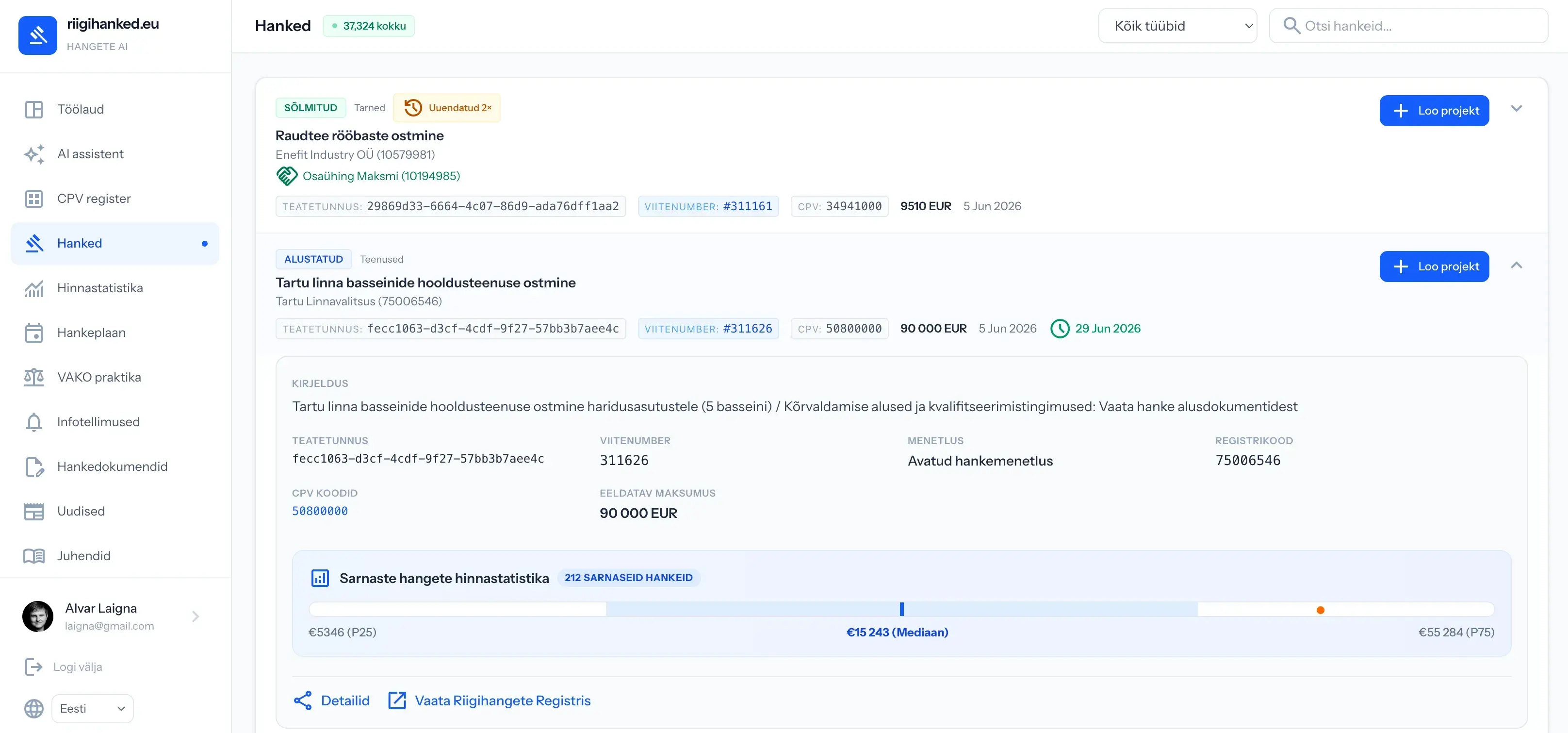
If you work in the public sector as a contracting authority, a procurement specialist, or a reviewer, I want to extend a direct invitation: I would love for you to try Riigihanked.eu to handle your next procurement.
We built this platform to make your life easier. It’s designed to help you prepare better procurement documents, check technical specifications, and compare supplier evidence without losing the strict process structure that the law demands.
The goal isn’t automation for its own sake. It’s to give you a tool that handles the tedious, error-prone work of cross-referencing hundreds of pages of documents, so you can focus on making sound decisions. The platform will cite its sources, highlight discrepancies, and show you exactly where to look. It will help you catch vague criteria before publishing and spot missing appendices in supplier bids.
If you are interested in seeing how a restrained, auditable AI assistant can speed up your workflow while keeping you firmly in control, please get in touch. I’d be happy to personally walk you through the platform and set you up.
Where to Next? UltraProcurements
Here is the part of the roadmap that excites me most. The next step for Riigihanked.eu is parallel agents: coordinated AI workers that take on your procurement project and run it like a team. One agent maps the award criteria, another cross-references supplier evidence, a third drafts the documents, a fourth checks everything against the directives, and an orchestrator keeps them honest and on schedule.
The inspiration comes straight from how we build software today. Anthropic’s UltraCode spins up a dynamic workflow of agents that divide a coding task, work in parallel, verify each other’s results, and synthesize the outcome. We are building the same idea for public procurement. Call it UltraProcurements.
The governance model does not move an inch. Every agent operates inside the same four layers, every claim stays cited, confidentiality boundaries hold, and the official still makes every decision. What changes is throughput: preparation that takes a procurement team days could be ready for human review in minutes. Agents do the legwork like a well-drilled team. You stay the decision-maker.
The Real Opportunity: Useful, Boring, Trustworthy
The next wave of AI products needs to be less theatrical. We don’t need more flashy demos of chatbots speaking in a confident legal tone. We need tools that know when to stay quiet, cite their sources, ask for human review, compute formulas accurately, protect confidentiality, and leave the final decision where it belongs.
That is the entire point of Riigihanked.eu. It’s a case study in a more serious kind of AI product, one where the flashy parts are deliberately subordinated to the boring parts. The database boundaries matter. The audit ledgers matter. The exact paragraph citations matter. The official’s final decision matters.
AI is incredibly powerful, and government work is incredibly serious. Procurement is political in the deepest democratic sense because it dictates how public money becomes public reality. If we want to bring AI into that process, we shouldn’t be asking how much human judgment we can automate. We should be asking how we can build a better environment for humans to make those judgments.
That is the version of AI worth building.
