Marketing in 2026
In 2026, the marketing is defined by a paradox the more autonomous and invisible AI becomes, the more radical and essential human authenticity is. This article explores the strategic shifts that will define the next era of marketing.
The Boardroom Paradox of 2026
Imagine it’s Tuesday morning, late 2026. Elena, a CMO, sits before her board. The room is silent, waiting for the quarterly strategy. Three years ago, this meeting would have been about “Digital Transformation” or “AI Adoption.” Today, those words feel archaic. Elena doesn’t talk about using AI; her team doesn’t “use” AI anymore than they “use” electricity – it is simply the invisible infrastructure running the lights.
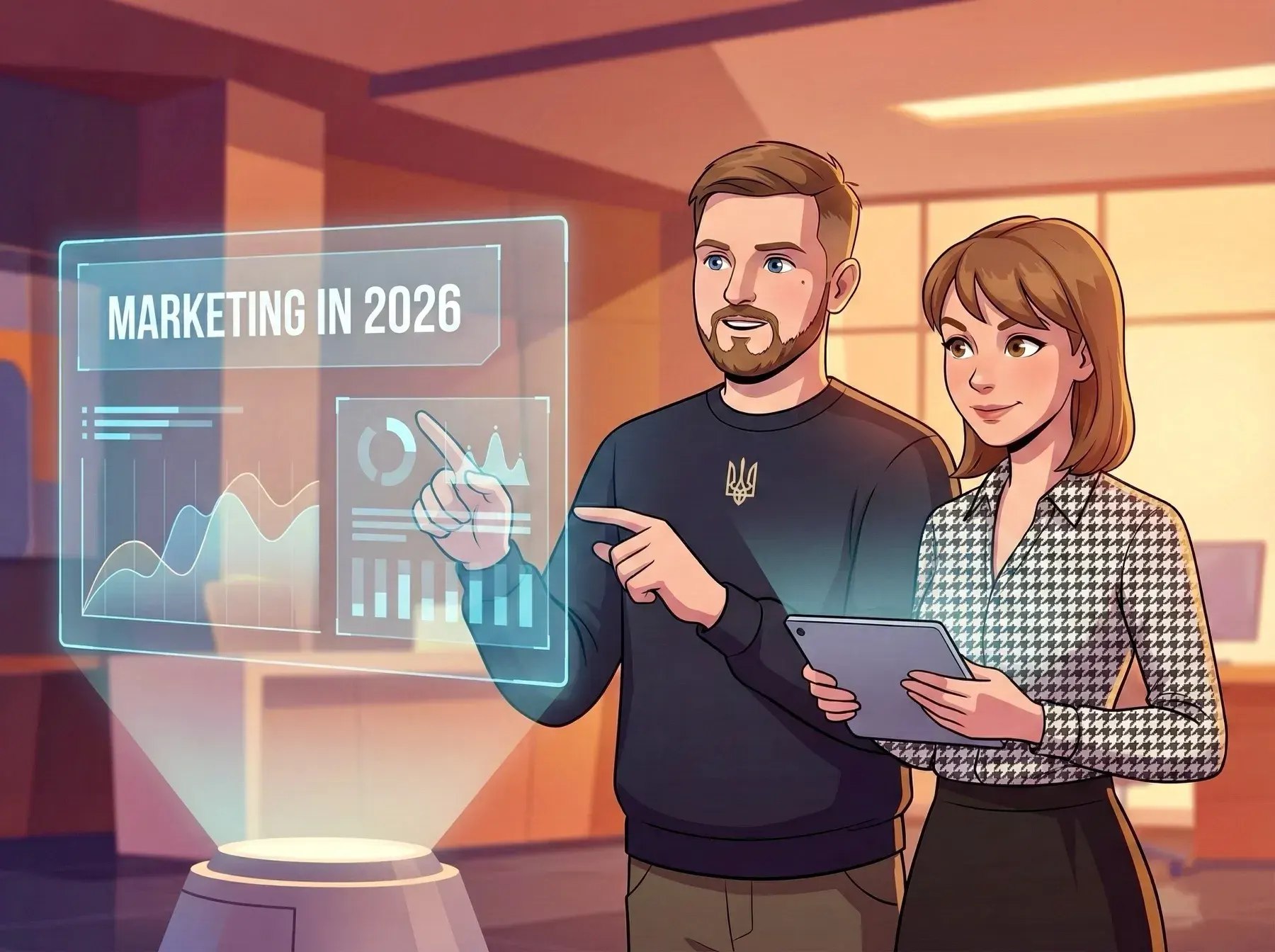
On the screen behind her, an AI Agent named “Comet” is autonomously optimizing thousands of ad variants in real-time, shifting budget based on a predictive algorithm that caught a micro-trend in rural migration before any human analyst could. It’s efficient, brutal, and flawless. But Elena turns the screen off.
“Comet is running the machine,” she tells the board. “But our competitors have an Comet, too. Efficiency is no longer a competitive advantage; it is table stakes. The only thing we have that they can’t replicate is our imperfections.”
She pitches the 2026 campaign: “Perfectly Imperfect.” No polished influencers. No AI-smoothed skin. Just raw, verifiable stories of customers using the product, flaws and all. In a world of infinite, cheap, synthetic content, Elena argues that the most premium asset left is proof of humanity. The board looks at the black screen, then at her. They realize that in the environment of the autonomous agents, the most radical marketing move is to be undeniably human.
This narrative is the emerging reality of marketing in 2026. This article builds upon the themes I explored in my “Marketing in 2025” article, which you can read on Medium and on my personal blog. The seismic shift is no longer about adopting AI, but about a world where AI is ubiquitous. The focus has moved from AI as a tool to Invisible AI, a silent infrastructure that powers everything. In this new period, the competitive advantage is not technological, but deeply human.
The “Unshittification” of Marketing
After years of AI-driven content overflow, a powerful counter-movement has emerged: the “unshittification” of marketing. Consumers are tired of the fake, the formulaic, and the fast. They are craving intentionality, meaning, and authenticity.
To win in 2026, brands must master the delicate balance between the autonomous efficiency of AI and the “perfectly imperfect” nature of human connection.
Here are the key strategic shifts that will define marketing in 2026:
From Generative AI to “AI Agents” eg Agentic
Marketers manually prompting chatbots is ending. In 2026, we are moving from using AI as a simple tool to deploying AI Agents – autonomous systems that can plan, execute, and optimize complex marketing campaigns with minimal human intervention. These agents will handle everything from real-time A/B testing to dynamic budget allocation, freeing up marketers to focus on high-level strategy, creativity, and building human relationships.
Search Changes Forever
Traditional Search Engine Optimization (SEO) is being replaced by Generative Engine Optimization (GEO). The new goal is to optimize for AI answer engines like Perplexity, Grok, and Gemini, which requires structured data, authoritative sourcing, and direct, conversational answers, not just keywords. We are also entering a zero-click world, where users get their answers directly from the search results page without clicking on a link. This means that winning the “Featured Snippet” and “People Also Ask” boxes is more critical than ever.
The “Human-First” Counter-Movement
As a direct response to the flood of AI-generated content, consumers are actively seeking out brands that feel real. This “human-first” movement is about authenticity & survival strategy. Brands must embrace their flaws and showcase “perfectly imperfect” behind-the-scenes content to prove their humanity. The focus is shifting from building passive audiences to creating active communities in private forums like Discord and Slack, and through human-first media like newsletters.
The Seamless “Shop-able” Feed
Social commerce is set to explode, reaching an estimated $2.9 trillion by 2026. The future is “shoppable everything,” with product feeds seamlessly integrated into video content, allowing users to make purchases without ever leaving their social media apps. This is coupled with hyper-personalization, where AI predicts customer needs before they even ask, creating truly individualized experiences. On the same time as inflation grows and youth social media usage is being limited it also brings the pace down a little.
The Unavoidable Trust Imperative
With the EU AI Act becoming fully applicable in 2026, data privacy and governance are no longer optional. The “cookie apocalypse” is here, and marketers must rely on first-party data and build “clean rooms” to manage it. In an age of deepfakes and misinformation, verification is a business imperative. Brands need to offer verifiable proof of their claims and content origins to build and maintain trust.
The Evolving Role of the Marketer
The role of the marketer is transforming. With low-code AI tools, marketers are becoming more like product managers, involved in prototyping and product development. As AI automates technical skills, “durable skills” like critical thinking, leadership, and communication are becoming the most valuable assets for marketing professionals. When we have infinite AI-generated content, human “taste” and design curation will be the ultimate competitive advantage.
Reaching the “Gleamer” Consumer
A key consumer profile for 2026 is the “Gleamer”, a pragmatic optimist who seeks out “minorstones” (small, tangible wins) rather than major life milestones. To connect with Gleamers, brands need to celebrate small accomplishments, facilitate community hubs or “third spaces,” and focus on providing tangible value and joy.
The Paradox of 2026: A Final Thought
The central paradox of marketing in 2026 is this: the more integrated and invisible AI becomes, the more essential and radical human “proof points” become. The path forward is not to chase every new micro-trend, but to focus on the fundamentals: building a strong brand and creating genuine human connections.
The brands that will win in 2026 will be those that use the machine to prove they are not one. This article originally appeared on my Medium. You can also read all of my articles here on my web.
